Finding the Sum of the Arithmetic Sequence
An arithmetic sequence is a sequence of numbers such that the difference between two consecutive terms is constant. The sequence
7, 13, 19, 25, 31, 37, 43, 59
is an example of an arithmetic sequence with first term 7, constant difference 6, and last term 49.
You have learned in that the formula for finding the nth term of the arithmetic sequence 


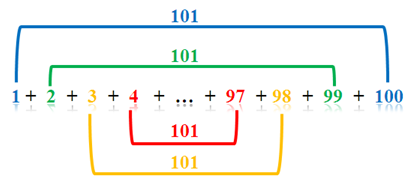
In this post, we derive the formula for finding the sum of all the numbers in an arithmetic sequence. We take the specific example above and use Gauss’ method in finding the sum of the first 100 positive integers. Recall that in adding the first 100 integers, Gauss added the first integer to the last, the second integer to the second to the last, the third integer and the third to the last and so on.
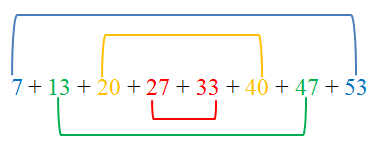
As we can see, this strategy can be applied to the given above. If we add the 1st and the 8th term, the 2nd and the 7th term, and so on, the sums are the same. Observe that the sequences has 8 terms and we have 8/2 = 4 pairs of numbers with sum 60.
Now, how do we generalize this observation?
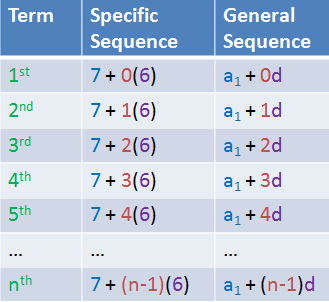
First notice that to get the terms in the sequence, the multiples of the constant difference is added to the first term. For example, to get the second term, we have 7 + (1) 6, and to get the third term, we have 7 + 2(6). Continuing this pattern, we can see the complete terms the second column in the table below. Their generalized form are shown in the third column.
If we use Gauss’ strategy in finding the sum of the generalized arithmetic sequence, 



But we have 


![S = \displaystyle\frac{n}{2}[(2a_1 + (n-1)d]](http://s0.wp.com/latex.php?latex=S+%3D+%5Cdisplaystyle%5Cfrac%7Bn%7D%7B2%7D%5B%282a_1+%2B+%28n-1%29d%5D&bg=ffffff&fg=000&s=0&c=20201002)
Take note that the preceding formula can be expanded to ![S = \frac{n}{2}[a_1 + a_1 + (n - 1)d]](http://s0.wp.com/latex.php?latex=S+%3D+%5Cfrac%7Bn%7D%7B2%7D%5Ba_1+%2B+a_1+%2B+%28n+-+1%29d%5D&bg=ffffff&fg=000&s=0&c=20201002)

Consequently, it is easy to get the sum of an arithmetic sequence from