Category Archives: Problems Sets

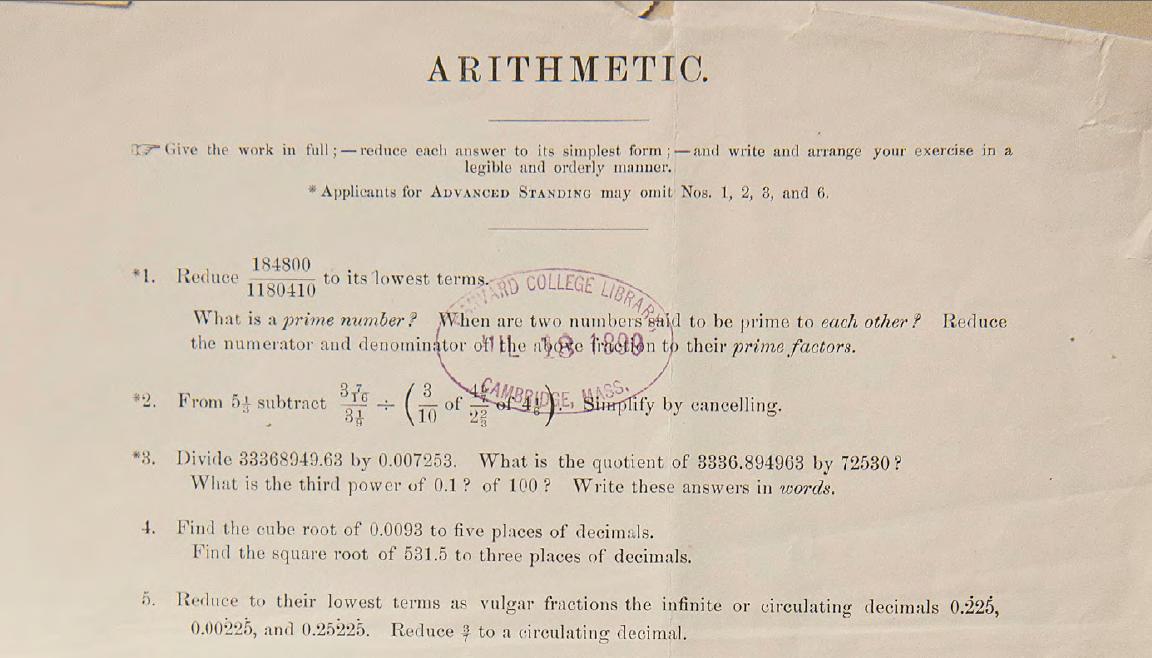
Would you have made it into Harvard in 1869?

If you think your tough in math and can pass the 1869 Harvard math exam, don’t rejoice so much because there are other subjects as well.

Click the picture to view full exam

Other subjects included are History and Geography, Latin Grammar, English to Latin Translation, Greek Grammar with accents, and Greek Composition :-D .

Surprisingly, according to the original article, 185 out of 210 examinees passed the exam.

More than 20,000 mathematics contest problems and solutions

Are you a math geek? Do you love solving problems? Do you like joining contests?
If you are, then this list is for you.  This list contains more than 20, 000 mathematics contest problems, many of which, have solutions and answers. Some of the links were taken from more than 14,000 problems collected by Art of Problem Solving. Continue reading

Problem Set 2

PROBLEMS

1.) Find a linear function f(x) such that f(1) = 42 and f(2) = 47.

2.) Solve for x: 4^{x+1} + 4^{x+2} +4^{x+3} +4^{x+4} = 170.

3.) Prove that the product of 3 consecutive numbers is always divisible by 6.

4.) Prove that if p is prime, a and b are integers, and a \equiv b\mod p, then a^p \equiv b^p \mod p.

SOLUTIONS AND PROOFS

Post Date: October 20, 2009

1. Solution: This is just the same as saying, find the equation of the line passing through (1,42) and (2,1337). So, by point slope formula, we have, y - y_1 = \displaystyle\frac{y_2 - y_1}{x_2 - x_1}(x - x_1)\Rightarrow y - 42 = \displaystyle\frac{1337 - 42}{2 - 1}(x - 1). \Rightarrow y = f(x) = -18x + 92.

2.) Solution:4^{x+1} + 4^{x+2} +4^{x+3} +4^{x+4} = 4^x(1 + 4 +4^2 +4^3) = 170 \Rightarrow 4^x(85) = 170\Rightarrow 4^x = 2 \Rightarrow 2^{2x}=2^1 \Rightarrow x = \displaystyle\frac{1}{2}.

3.) Proof: A number is divisible by 6 if it is divisible by 2 and 3. A product of 3 consecutive numbers is divisible by 2 because at least one of them is even, so it remains to show it is divisible by 3.

If a number is divided by 3, its possible remainders are 0, 1, and 2.  Assume n, n +1 and n+2 be the three consecutive numbers, and r be the remainder if n is divided by 3.

Case 1: If r=0, we are done.

Case 2: If r = 1, then n + 2 \Rightarrow r=0

Case 3: If r = 2, then n + 1 \Rightarrow r = 0.

Since the product of the three consecutive numbers is even, and for each case of r, one of the consecutive numbers is divisible by 3, the product of three consecutive numbers is divisible by 6. \blacksquare

4.) Proof: From definition, a^p \equiv b^p \mod p \Leftrightarrow b = a + kp for some k \in \mathbb{Z}.

Raising both sides of the equation to p, we have b^p = (a + kp)^p. By the binomial theorem,  b^p = (a + kp)^p = a^p + \displaystyle {p \choose 1}a^{p-1}kp + \displaystyle{p \choose 2}a^{p-2}k^2p^2 + \ldots + k^pp^p.

Notice that every term aside from a^p is divisible by p^2. (Why?). Therefore,  a^p \equiv 0 \mod p^2 .

Hence, then a^p \equiv b^p \mod p. \blacksquare

Related Posts Plugin for WordPress, Blogger...