Finding the General Formula for the kth Polygonal Number
If we represent numbers using “dots,” there are special numbers that can form “polygons.” Numbers that can form polygons are called polygonal numbers. For example, the square numbers 1, 4, 9, 16 and so on form a “square.” As shown below, it is easy to see that the 10th square number is a square with 10 rows and 10 columns. This means that the 10th square number is equal to 100 (has 100 dots).
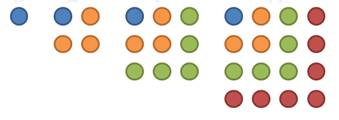
The Representation of Square Numbers
Like square numbers, triangular numbers form a shape. You guessed it right, the shape is a triangle. Finding the 15th triangular number seems hard, but we have already learned that triangular numbers are connected to the sum of the first m positive integers. The mth triangular number has

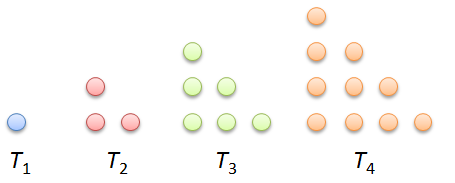
The Representation of Triangular Numbers
Notice that for each “polygonal number” a formula is needed to get the total number of dots. For example, we have not discussed pentagonal numbers yet, so it may take quite some time to determine the 10th pentagonal number. The question now is, can we find a formula to determine the number of dots given the “size” and “shape” of a polygonal number? For example, what is the 8th heptagonal number?
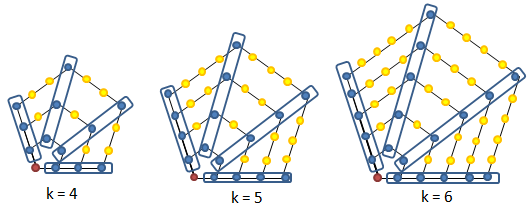
To answer this question, consider the next figure. In the figure, we see the geometric representations of square, pentagonal, and hexagonal numbers. Study the groupings of the dots before scrolling down and see if you can find some patterns.
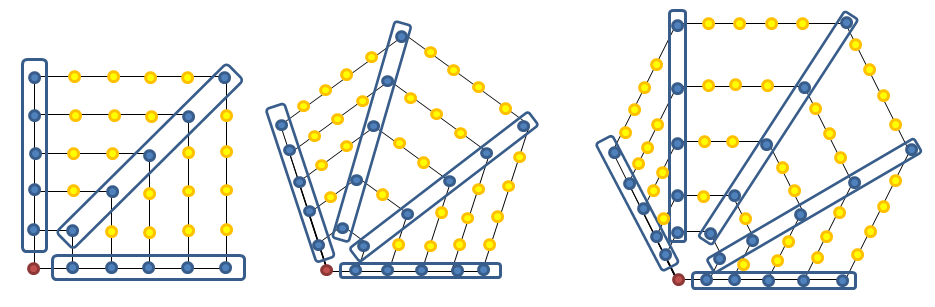
Click image to enlarge
First, we can observe that the yellow dots are triangular numbers. For brevity, let us call the yellow dots, triangles. Observe that the square numbers, pentagonal numbers, and hexagonal numbers have 2, 3 and 4 triangles respectively.
Second, we can observe the group of blue dots. Their rectangular border makes them look like a stick so we call each group a stick. Observe that the square numbers, pentagonal numbers, and hexagonal numbers have 3, 4, and 5 sticks respectively.
Third, notice that we have isolated the red dot.
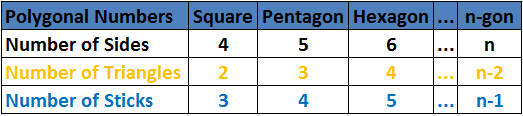
The table above shows the relationship among the number sides, the number of triangles, and the number of sticks in a polygon. We use these relationships to derive the general formula for polygonal numbers.
In finding the number of dots in a polygon, two quantities vary. The first varying quantity is the number of sides of the polygon which we have denoted above as n. The second quantity is the number of dots on each side of the polygon which we denote by k.
Click image to enlarge
Total Number of Dots on Sticks
The total number of dots on sticks is the product of the number of sticks in a polygon with n sides and the number of dots on each stick. From the table above, a polygon with n sides has (n – 1) sticks and the number of dots on each stick is (k – 1); that is, the number of dots on each side minus the red dot (see third figure). So, the total number of dots on sticks is 
Total Number Number of Dots on Triangles
The total number of dots on triangles is equal to the number of triangles times the number of dots on each triangle. Again, from the table above, a polygon with n sides has (n-2) triangles.
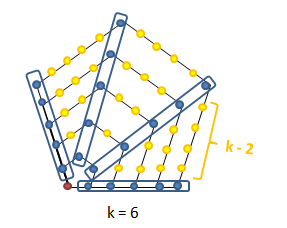
Now, the number of dots in each triangle is the sum of 1 + 2 + 3 + … + (k – 2) as shown above. Recall that that the sum of 1 + 2 + 3 + … + (m – 1) + m = 1/2 m (m + 1). If we let m = k + 2, then the total number of dots in each triangle is 1/2(k-2)(k-1).
Therefore, the total number of dots on all the triangles is equal to

The General Formula
To get the general formula, we add 1 (the red dot) to the total number of dots on the sticks and the total number of dots on the triangles. Therefore, the kth polygonal number (P) is described by the formula

We now answer the question above: “What is the 8th heptagonal number?”
A heptagon has 7 sides, so n = 7. The 8th heptagonal number has 8 dots on each side so k = 8. Substituting the values to the formula, we have

Therefore, the 8th heptagonal number is 253.
***
Proof by Dave Logothetti, Proofs without Words: Exercises in Visual Thinking