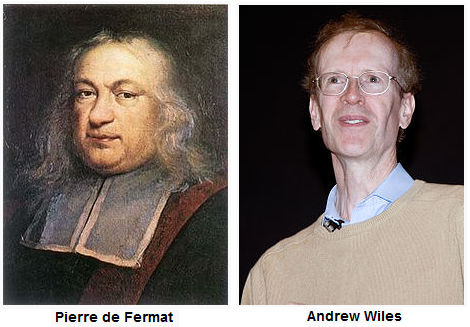
The Fermat’s Last Theorem is one of the hardest problems in the history of mathematics. The problem was written by Pierre de Fermat in 1637, and it was only solved more than 300 years later — in 1995 by Professor Andrew Wiles.
But what is exactly the Fermat’s Last Theorem?
The Fermat’s Last Theorem is an extension of the Pythagorean Theorem. Recall that the Pythagorean Theorem states that given a right triangle whose side lengths are and hypotenuse
,
is satisfied. For example, a right triangle with side lengths
, and
has hypotenuse
.

There are some interesting things that we can see if we examine the side lengths of right triangles. For instance, if we let the triples be the side lengths of a right triangle, where
is the hypotenuse, we can find triples such that all lengths are integers. The triples
,
,
are integer triples, and they satisfy the Pythagorean Theorem. These triples are called Pythagorean Triples. It is not also difficult to see that there are infinitely many Pythagorean Triples (Can you see why?).
As number theory developed, mathematicians observed that there are no positive integer triples that satisfy the equation above given larger integer exponents. For example, Fermat himself proved that there are no triples satisfying . Leonard Euler also proved that there are no integer triples satisfying
. Later in the 18th and 19th century, mathematicians proved that no such triples exist satisfying the equation for integral exponents up to four thousand. In fact, before these developments, Fermat thought that he proved that
*No positive integers
, and
can satisfy the equation
for all integers n greater than 2.
In one of his notebooks, he wrote that
I have discovered a truly marvelous proof that it is impossible to separate a cube into two cubes, or a fourth power into two fourth powers, or in general, any power higher than the second into two like powers. This margin is too narrow to contain it.
believing that he actually proved the then conjecture.
Although Fermat’s proof was never found, mathematicians believe that his proof was incorrect because the mathematics of his time was not enough to prove the theorem.
In 1995, Andrew Wiles shocked the mathematics world by proving The Fermat’s Last Theorem. He spent 7 years (plus more than a year of revision, since his first proof was flawed) in his attic before he finally solved the problem.
*This is called the Fermat’s Last Theorem.
_____
For more information, here is an excellent documentary about Fermat’s Last Theorem.
Photo Credit: Wikipedia


Pingback: Tweets that mention Understanding Fermat’s Last Theorem « Mathematics and Multimedia -- Topsy.com
Pingback: The Infinitude of Pythagorean Triples « Mathematics and Multimedia
Pingback: Top Posts for January 2011 « Mathematics and Multimedia
Pingback: Carnival of Mathematics #75 « General Musings
Pingback: Math Teaches at Play 36 and Carnival of Math 76 « Mathematics and Multimedia
Pingback: Pythagorean Triple 2: Generating Pythagorean Triples | Mathematics and Multimedia
OK but why is this theorem so important to mathematics?
I think it has a lot of applications in number theory particularly in encryption.
As Fermat’s Last Theorem(FLT) is not yet solved using elementary method, I believe that I have got the same using elementary method. And I have a question which has come out while solving FLT using elementary method.
We have equation as √{(b² + 1) ∕ 2} – 170 = Z , now find the minimum value of ‘b’ so that Z is a positive integer.It should be mathematically proved without using computer or Hit&Trial method.
I want to verify my work on FLT and the above question is a proof of my solving FLT using elementary method unlike of Prof. Andrew Wiles who has used Advanced method which was not known to the mathematicians of
Fermat time. Plese guide me in this regard.
Pingback: Where is the Nobel Prize in Mathematics?
Pingback: 7 Extraordinary Mathematicians You Should Know About
Pingback: Andrew Wiles: The Man Who Solved A Math Problem for 8 Years
Pingback: Sino ang pinakamagaling na mathematician?
Pingback: Ano ba ang ginagawa ng mga mathematicians?
Pingback: The Pythagorean Theorem
Pingback: The Actual Fermat-Pascal Correspondence