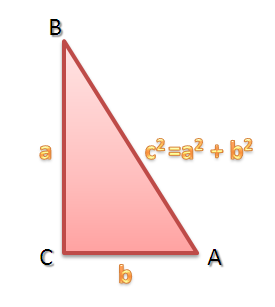
In my Algebraic and Geometric Proof of the Pythagorean Theorem post, we have learned that a right triangle with side lengths  and
and  and hypotenuse length
  , the sum of the squares of and is equal to the square of . Placing it in equation form we have
  .
.
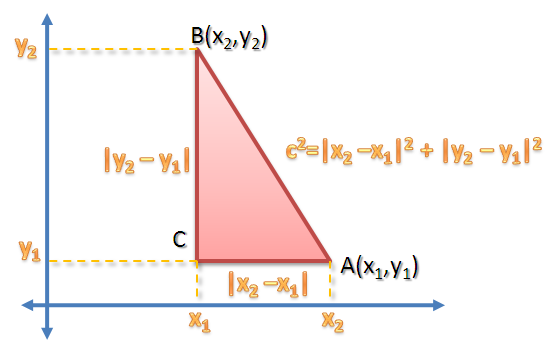
If we place the triangle in the coordinate plane, having  and
and  coordinates of
  and
and  respectively, it is clear that the length of
  is
is  and the length of
  is . We are finding the length, which means that we want a positive value; the absolute value signs guarantee that the result of the operation is always positive. But in the final equation,
 , the absolute value sign is not needed since we squared all the terms, and squared numbers are always positive. Getting the square root of both sides we have,

We say that is the distance between and , and we call the formula above, the distance formula.
If we want coordinates of  where
where  and
and  are variables and the distance of from constant, say
  , then moving point about point
  maintaining the distance forms a circle. If has coordinates
  , then
  which means that
  .
.
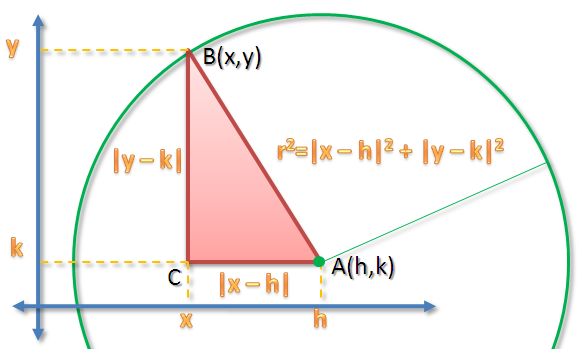
Observe that the two equations above are all of the same form, they are all consequences of the Pythagorean Theorem. The examples are probably very elementary, but it shows one of the rare beauties of mathematics — the strong connections between and among different concepts.